Flat-Rate vs Per-GB Proxies: The Breakeven Math
By Nicholas St. Germain. Published
Proxy pricing comes in two shapes. Either you pay for the IP address itself, a flat monthly fee no matter how much traffic you push through it, or you pay for the bytes, metered by the gigabyte as they pass through a shared pool. Every provider's marketing treats its own shape as the natural one.
The choice between them is one division: a per-IP price over a per-GB rate, compared against how much traffic each of your IPs actually moves in a month. Most comparisons wave at "depends on your use case" and stop before quantifying anything. This post does the division against real price lists checked in July 2026, links every source, and works through three scenarios so you can see where the crossover sits for jobs people actually run.
Our bias, on the table first
Stat Proxies sells flat-rate static ISP proxies: US-only static IPs on Tier-1 US carrier ranges, from $2.50 per IP per month, unlimited bandwidth, username:password auth over HTTP, HTTPS, or SOCKS5. We do not sell anything metered. So of course we like how this math comes out.
That is why every step is shown. The formula is one line, and each price in the table links to the provider's own page. The section on when per-GB wins is not buried at the bottom in small type. If your workload lands on the metered side of the line, buy metered. We name the cases where you should.
Flat-Rate vs Per-GB Proxies: Key Differences
Per-GB pricing meters traffic. You draw connections from a large shared pool, usually residential. Each request can exit from a different address, and the bill is gigabytes moved times the rate. Rates drop as you commit to bigger monthly blocks, typically from around $8/GB pay-as-you-go down to under $2/GB at multi-hundred-GB commitments.
Flat per-IP pricing rents the address. You get specific static IPs that stay yours for the whole billing period, and the bill is IP count times the monthly rate. Traffic is free. Or it should be.
That "should be" carries real weight. Some flat-priced products are quietly metered: Bright Data's dedicated ISP proxies carry a 100 GB per month fair-usage allowance with overage charges, and Webshare's headline $0.30 static residential proxies share a 250 GB bandwidth pool, with the unmetered variant starting at $0.90 per proxy. We walked through the same fine print on the residential side in our teardown of "unlimited bandwidth residential" offers. When a flat price looks surprisingly low, find the bandwidth clause before running any of the math below.
The one formula
Here is the entire decision:
breakeven_GB_per_IP_per_month = per_IP_price / per_GB_price
If an IP moves less than that many gigabytes in a month, per-GB is cheaper for that traffic. If it moves more, flat-rate is cheaper. That is the whole model. Everything else in this post is just plugging in real numbers.
As runnable code, against our own $2.50 IP:
def breakeven_gb_per_ip(per_ip_monthly: float, per_gb: float) -> float:
    """GB per IP per month at which flat-rate and per-GB cost the same."""
    return per_ip_monthly / per_gb

per_gb_rates = {
    "Bright Data residential PAYG (list)": 8.00,
    "Oxylabs residential Starter": 6.00,
    "IPRoyal residential 50 GB": 5.15,
    "Decodo residential PAYG": 4.00,
    "Webshare residential 1 GB (promo)": 3.50,
    "Webshare residential 3,000 GB": 1.40,
}

for plan, rate in per_gb_rates.items():
    print(f"{plan}: {breakeven_gb_per_ip(2.50, rate)} GB/IP/month")
The breakeven table, pricing checked July 2026
All prices below were pulled from the providers' own pricing pages on July 23, 2026. Promotional prices are labeled, because two of these providers are mid-sale and the sticker you see today may not be the price you renew at.
| Per-GB plan | Price per GB | Breakeven vs a $2.50 flat IP |
|---|---|---|
| Bright Data residential, pay-as-you-go | $8.00 list; $4.00 on the current 50%-off coupon | 0.31 GB (0.63 GB at promo) |
| Bright Data residential, $1,999/mo committed | $2.50 promo (list $5.00) | 1.00 GB |
| Oxylabs residential, pay-as-you-go | $8.00 (per their help center; capped at 50 GB/mo) | 0.31 GB |
| Oxylabs residential, Starter $30/mo | $6.00 | 0.42 GB |
| Oxylabs residential, Corporate $2,500/mo | $2.50 | 1.00 GB |
| Decodo residential, pay-as-you-go | $4.00 + VAT | 0.63 GB |
| Decodo residential, 100 GB plan | $2.75 + VAT | 0.91 GB |
| IPRoyal residential, 1 GB | $7.35 | 0.34 GB |
| IPRoyal residential, 50 GB | $5.15 | 0.49 GB |
| Webshare residential, 1 GB | $3.50 promo (regular $7.00) | 0.71 GB (0.36 GB at regular) |
| Webshare residential, 3,000 GB | $1.40 | 1.79 GB |
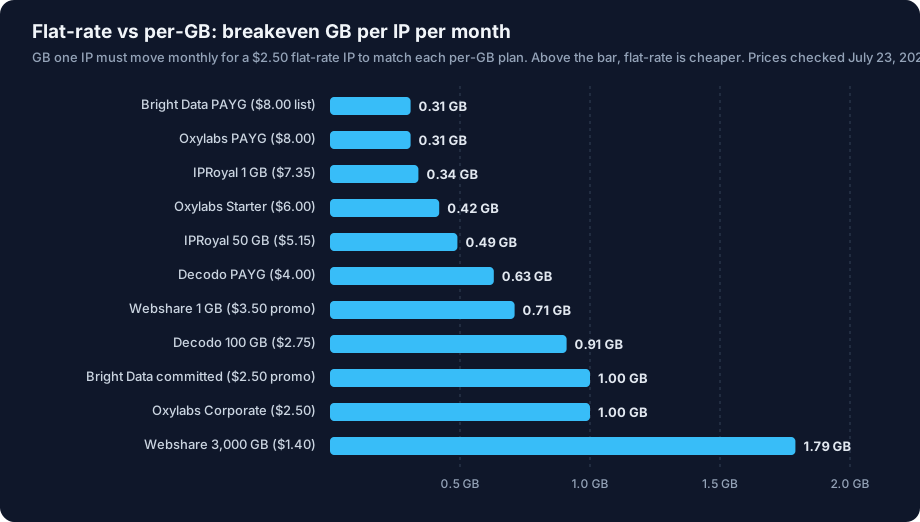
Read the right column carefully. The worst case for flat-rate in this entire table is 1.79 GB per IP per month, and reaching it requires buying 3,000 GB of Webshare traffic every month. Every pay-as-you-go rate breaks even below two-thirds of a gigabyte.
To make those numbers physical: the median web page weighs about 2.94 MB on desktop per the HTTP Archive's July 2026 crawl, so 1 GB is roughly 340 median page loads. The $8/GB rates break even at about 105 pages per IP per month, three or four page loads a day. Even the deepest bulk tier breaks even around 610 pages a month, about 20 a day. If an IP does more than a trickle of real page traffic, metering loses.
For fairness, flat-rate is not only us. Bright Data sells dedicated ISP IPs from $3.50 down to $2.50 per IP (with that 100 GB fair-use cap), and IPRoyal's static residential line starts around $2.70 per proxy for 30 days, cheaper on longer commitments. The math below works the same way for any of them; substitute your own per-IP price.
Worked example 1: price monitoring
Say you monitor 2,000 product pages a day across a handful of US retailers, the bread-and-butter price monitoring workload. Assumptions, stated: each page transfers the desktop median of about 2.94 MB from the HTTP Archive figure above, and a month is 30 days. If you fetch bare HTML or JSON endpoints and skip images, your real transfer could be ten times lower, which pulls the metered bill down. Rerun the numbers with your own byte counts.
Price monitoring on per-GB pricing
At the median: 2,000 pages × 2.94 MB = 5.88 GB per day, about 176 GB per month. On pay-as-you-go at $4/GB that is roughly $706 a month. Committed tiers help but not enough: two of Decodo's 100 GB blocks at $275 each run $550, and Webshare's 250 GB tier at $2.00/GB is a $500 block.
Price monitoring on flat-rate IPs
On flat-rate, bandwidth is irrelevant and the only question is how many IPs you need to stay under the targets' per-IP tolerance. Assume, and this is our assumption, that you keep each IP to around 200 page requests a day per site to stay polite. That is 10 IPs at $2.50, $25 a month, with each IP moving about 18 GB, far past every breakeven in the table. Triple the IP count for headroom and you are still at $75 against a $500-700 metered bill.
Worked example 2: multi-account management
Now the opposite traffic profile. You run 25 seller or social accounts, and each one needs its own stable IP that looks residential and never changes. The traffic per account is trivial: logins, a dashboard, some posts, call it 100 MB a month each as our assumption. Total: 2.5 GB, which at $4/GB is ten dollars. Metered looks cheap here.
Why multi-account management needs static IPs
Except metered is the wrong product here, and price is beside the point. Shared pools rotate by design, and sticky sessions hold an IP for minutes or hours, not months. An account that appears to log in from a new city every week is exactly what platform risk systems are trained to catch. This workload needs the same address every day, and that is per-IP pricing by definition, which metered pools do not sell. Even the per-GB vendors concede the point: IPRoyal prices its static residential product flat, per proxy, from about $2.70 for 30 days rather than by traffic. 25 static IPs at $2.50 come to $62.50 a month, and the bandwidth term drops out of the equation entirely.
Worked example 3: high-volume scraping
At the other extreme, take a crawler moving 20 GB a day, 600 GB a month, against US targets that tolerate steady request rates.
High-volume scraping on per-GB pricing
Metered pricing at this volume is a serious line item. Webshare's 1,000 GB tier at $1.50/GB means a $1,500 monthly block (or $875 for 500 GB plus overflow), Decodo's best listed non-enterprise rate of $2.75/GB prices 600 GB around $1,650, and mid-ladder rates near $4/GB put it at $2,400. The bill scales with your success and grows every time you add a target.
High-volume scraping on flat-rate IPs
On flat-rate the bill scales with IP count instead. Assume 40 IPs sustain your request rate across targets: $100 a month, with each IP moving 15 GB, roughly 8 to 48 times the breakeven of every plan in the table. Note that 15 GB per IP would also sit comfortably under fair-use caps like Bright Data's 100 GB, but heavier single-IP loads would not, which is why the unlimited-bandwidth clause matters at this end of the scale.
When per-GB pricing wins
Here is the section a metered-proxy seller would write about us. Per-GB is the right call when:
- You need many geographies at low volume each. Stat is US-only, full stop. If tomorrow's job needs eyes in 15 countries, a residential pool billed by the GB is the sane tool, and no US ISP proxy helps you.
- Your volume is tiny and irregular. For a one-off few-GB job, pay-as-you-go traffic with no subscription wins outright. IPRoyal's residential traffic never expires, which suits occasional work especially well.
- The target is hostile enough to demand rotation. Serious bot management burns IPs on a schedule of its own. A small set of static addresses, ours included, gets fingerprinted and blocked, while per-request rotation across a pool of millions keeps the success rate up. On those targets the metric that matters is successful requests, not dollars per GB, and static ISP proxies lose plainly.
One more honest limit that applies to both models: a proxy only changes your IP. If the challenges you see come from TLS fingerprints or headless-browser detection, no billing model fixes that. Fix the client first.
The real cost axis is IP count, not bandwidth
An unlimited-bandwidth flat IP is still one IP. Targets do not care that your bandwidth is free; they rate-limit per address, so the way you scale a flat-rate setup is by buying more IPs, and that, not gigabytes, is the real cost axis of this model. We wrote up the sizing math, requests per IP per day against target tolerance, in how many proxies you actually need. Budget for burn, too: on rough targets some IPs will get blocked, and you will want to swap them (our management API handles IP replacement programmatically, so a burned address does not mean a support ticket).
Flat-rate does not make cost go away. It moves cost onto an axis you control: request pacing and IP count are engineering decisions you can tune. Bytes transferred mostly are not, because the target's page weight decides them for you.
Run your own numbers
Take the one-line formula, your real per-IP quote, the per-GB rate you would actually pay, and your measured GB per IP per month. The division takes ten seconds and it does not care about anyone's marketing, including this post. If you land on the flat side and your targets are in the US, our ISP proxies start at $2.50 per IP with unmetered bandwidth and no fair-usage cap, and business users can contact sales to discuss a trial.
FAQ
What's the difference between flat-rate and per-GB proxies?
Per-GB proxies meter traffic: you draw connections from a shared pool, usually residential, and pay for each gigabyte moved, at rates from around $8 per GB pay-as-you-go down to under $2 per GB on large commitments. Flat-rate proxies rent the address itself: specific static IPs billed at a fixed monthly price per IP, with traffic included, though some flat products carry hidden bandwidth caps. Which model costs less depends on how many gigabytes each IP moves per month.
How do I calculate the breakeven between flat-rate and per-GB proxies?
Divide the monthly per-IP price by the per-GB rate. The result is the number of gigabytes one IP must move per month for the two models to cost the same. Below that traffic level per-GB is cheaper; above it flat-rate is cheaper. Against a $2.50 per month IP, breakevens for July 2026 residential rates fall between roughly 0.3 and 1.8 GB per IP per month.
Are unlimited-bandwidth flat-rate proxies really unlimited?
Not always, so read the bandwidth clause before comparing prices. Some per-IP products carry fair-usage caps, such as 100 GB per month per IP with overage charges, or share a fixed bandwidth pool across all your proxies. Stat Proxies' ISP proxies have no metering or fair-usage cap, which is why we publish this comparison at all.
When are per-GB proxies actually the better deal?
When total volume is very low, when the work is occasional one-off jobs rather than a standing monthly load, when you need many countries at small volume each, or when the target aggressively blocks repeated IPs and you need per-request rotation across a large pool. In those cases metered residential pricing beats any flat-rate static IP.
Does unlimited bandwidth on one IP remove rate limits?
No. Rate limits are enforced per IP address by the target site, so a single flat-rate IP can still only sustain whatever request rate the target tolerates. Scaling a flat-rate setup means adding IPs, which is why IP count, not bandwidth, is the real cost driver of the flat model.